“Resonations”: The Heinrich Boell Stiftung Tel Aviv launches its 2026 Arts and Culture Program! “Resonations” is a year-long arts and culture framework of the Heinrich Böll Stiftung Tel Aviv that creates spaces for encounter, reflection, and dialogue across Israel’s diverse communities. Through literature, film, visual arts, music, performance, and interdisciplinary formats, it addresses questions of gender equality, human rights, social and environmental justice, while amplifying voices often marginalized in mainstream discourse. Against the backdrop of the horrific past years, the framework uses artistic expression to engage with complexity, trauma, dissent, and possibilities for coexistence. Developed with cultural and civil society partners across Israel, and including selected German perspectives, “Resonations” unfolds throughout 2026 as a decentralized series of interconnected events.
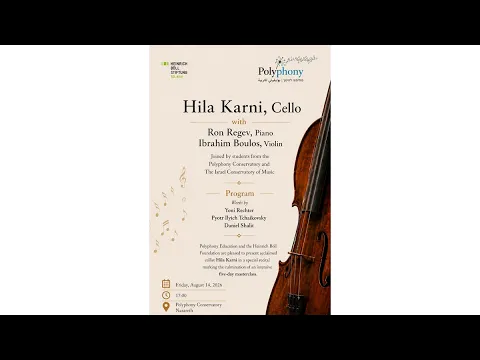
The first project of the Resonations Program presents musical exchange of Jewish and Palestinian musicians from Israel. In partnership with the Polyphony Conservatory in Nazareth, two residency events are scheduled for August and November 2026. Led by acclaimed Cellist Hila Karni (Berlin-based Israeli), each residency event includes a five-day residency which included individual instruction, masterclasses, chamber-music coaching, rehearsals, and shared musical work, where Israeli Palestinian and Jewish musicians have come together in pursuit of musical excellence.
A part of the project, the first recital will take place in the afternoon of Friday, August 14th, 2026, at the Polyphony Conservatory in Nazareth, featuring Karni, Pianist Ron Regev and Violinist Ibrahim Boulus, who will play a diverse range of works with students from both Polyphony Conservatory (Nazareth) and The Israel Conservatory of Music (in Tel Aviv). The project will resume later this year, with a second residency program and a recital during November 2026.
This unique project reflects the foundation’s values of cross-community dialogue, artistic exchange, equality, and the creation of spaces in which Arab and Jewish participants can develop meaningful cooperation, and demonstrate how cultural education can contribute to empathy, mutual respect, and a more inclusive shared society.